

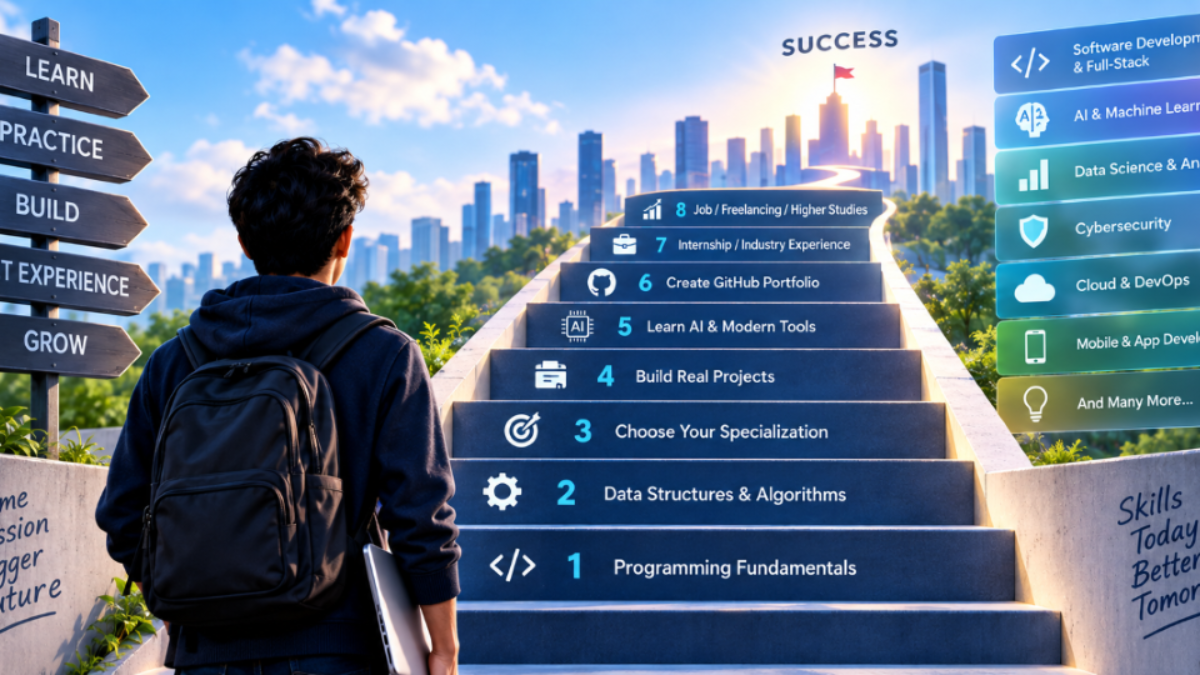
Starting a career in Computer Science (CS) or Information Technology (IT) can feel overwhelming. There are many career options—from software development and Artificial Intelligence to cybersecurity, cloud computing and data science.
The good news is that you don’t need to learn everything at once. A clear career roadmap for CS & IT students can help you build the right skills step by step.
Step 1: Build Strong Programming Fundamentals
Start with one programming language instead of trying to learn several at once.
Popular choices include:
- Python – AI, Data Science, Automation
- JavaScript/TypeScript – Web Development
- Java – Enterprise and Backend Development
- C/C++ – Systems, Robotics and Game Development
Focus on variables, loops, functions, OOP, debugging and problem-solving.
Step 2: Learn Data Structures & Algorithms
Once you understand programming, learn Data Structures and Algorithms (DSA).
Important topics include:
- Arrays and Strings
- Linked Lists
- Stacks and Queues
- Trees and Graphs
- Searching and Sorting
- Algorithmic Problem Solving
DSA helps students develop logical thinking and prepare for technical interviews.
Step 3: Choose Your Career Specialization
After building your foundation, choose an area that matches your interests.
Software & Full-Stack Development
Learn HTML, CSS, JavaScript/TypeScript, databases, APIs and modern frameworks.
AI & Machine Learning
Learn Python, statistics, Machine Learning, Generative AI, LLMs and AI APIs.
Data Science & Analytics
Learn Python, SQL, statistics, data visualization and tools such as Power BI or Tableau.
Cybersecurity
Learn networking, Linux, security fundamentals, ethical hacking, secure coding and cloud security.
Cloud & DevOps
Learn Linux, Git, cloud platforms, containers, CI/CD and infrastructure concepts.
Mobile & App Development
Learn Android, Flutter, React Native or another suitable mobile development stack.
Step 4: Build Real Projects
Projects are one of the best ways to turn knowledge into practical skills.
Instead of only watching tutorials, build projects such as:
- AI chatbot
- E-commerce website
- Data dashboard
- Mobile application
- Cybersecurity lab project
- Cloud-based application
- Automation tool
Add your best projects to your GitHub portfolio.
Step 5: Learn AI-Assisted Development
AI is changing software development, so CS & IT students should learn how to work with AI, not simply compete against it.
Learn how to use AI tools for:
- Code generation
- Debugging
- Documentation
- Testing
- Research
- Learning new technologies
But always understand and review the code generated by AI.
Step 6: Develop Career Skills
Technical knowledge alone isn’t enough.
Also improve:
- Communication
- Teamwork
- Problem-solving
- Presentation skills
- Time management
- Interview skills
- Professional networking
These skills can make a significant difference when applying for internships and jobs.
Step 7: Get Internship & Industry Experience
Try to gain practical experience through:
Projects → Hackathons → Internships → Freelancing → Open-source contributions
Real-world experience helps you understand how technology is actually used in professional environments.
A Simple CS & IT Career Roadmap
Programming Fundamentals
↓
DSA & Problem Solving
↓
Choose a Specialization
↓
Build Real Projects
↓
Learn AI & Modern Tools
↓
Create GitHub Portfolio
↓
Internship / Industry Experience
↓
Job / Freelancing / Higher Studies
Final Thoughts
A successful CS & IT career doesn’t happen overnight. The key is to build your fundamentals first, choose a specialization, work on real projects and continuously update your skills.
You don’t need to know everything.
Learn → Build → Practice → Get Experience → Keep Growing.
I wonder if there’s any reason why the same can’t be said for simply staying up later? If it’s about time to do nothing, or to exercise, or to be bored, you would assume the same can be achieved at 1am when you haven’t slept yet as it can at 5am when you’ve just gotten up.
I wonder if there’s any reason why the same can’t be said for simply staying up later? If it’s about time to do nothing, or to exercise, or to be bored, you would assume the same can be achieved at 1am when you haven’t slept yet as it can at 5am when you’ve just gotten up.